The MedTech CRO Model Was Built for a Different Customer
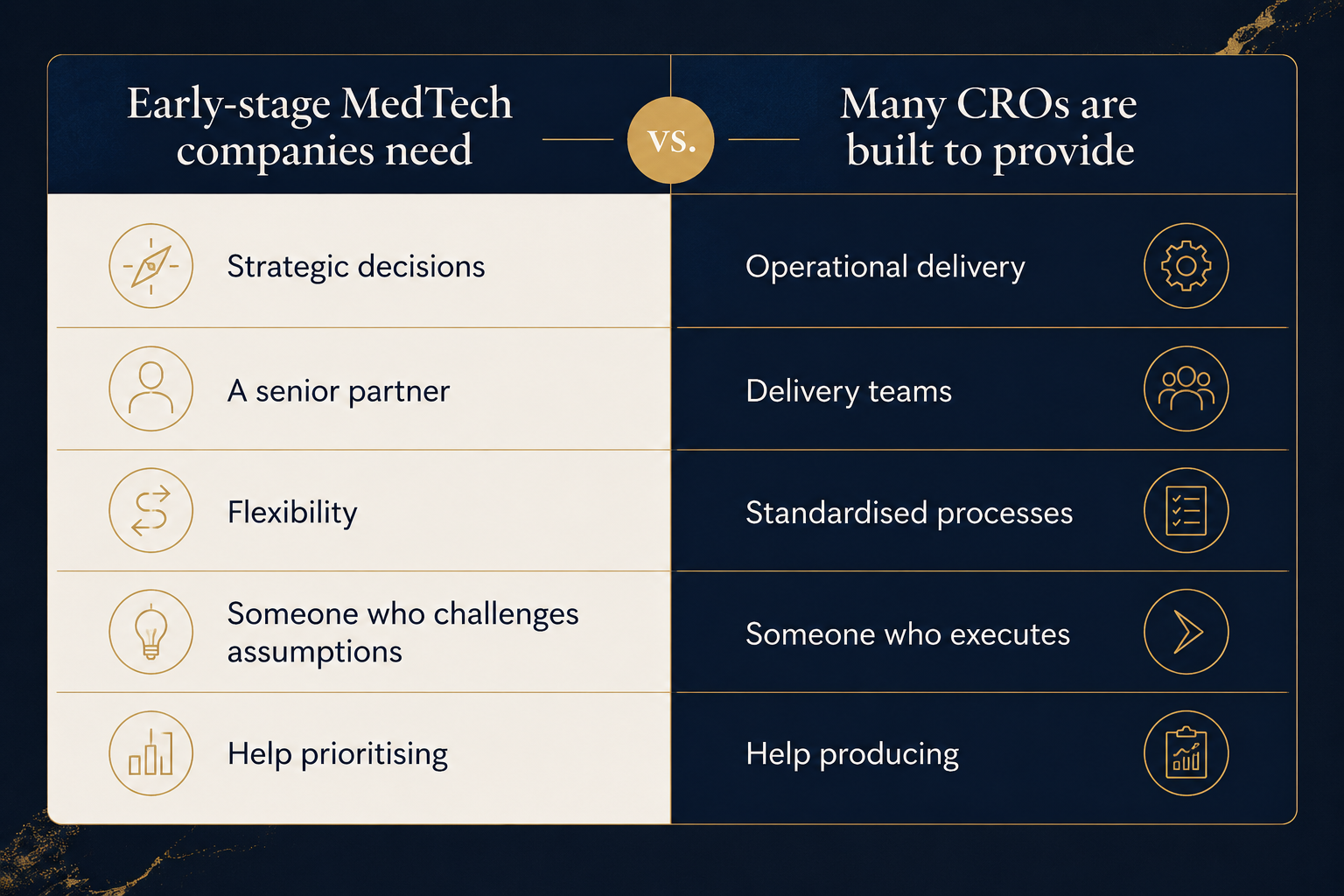
The value in MedTech consulting is shifting from execution to judgement. The industry's business model hasn't caught up yet.
There is a recurring pattern that I have seen many times throughout my years in the MedTech industry, particularly in early product development, among startups, and within smaller companies.
A typical scenario involves a company approaching a CRO to request a quotation for a clinical study. The material provided often includes a study plan, a synopsis, or some form of project description. The ambition is genuine, and the company usually has a clear understanding of what it wants to achieve at a high level. At the same time, many of the most critical questions remain unanswered.
The Intended Purpose is often only partially defined, while claims are either incomplete or insufficiently substantiated. Endpoints have not been fully challenged. The role of the study within the broader regulatory strategy remains unclear. In some cases, there is not even a clear answer to the regulatory or commercial question the study is ultimately intended to address.
Yet the conversation often begins with the same question: "What will the study cost?"
It is not a strange question. For a young MedTech company, it is natural to view the situation as an execution problem. The technology has been developed, clinical studies appear to be the logical next step, and so the company approaches the organization expected to conduct them.
The CRO, however, often sees something entirely different. So, the company believes it is buying a study. The CRO frequently sees a project that is not yet sufficiently defined to be planned, budgeted, or executed in any meaningful way.
As a result, the first meetings rarely focus on execution. Instead, the discussion shifts toward product classification, study design, regulatory expectations, data collection, safety management, statistical planning, and evidence strategy. After a period of time, both parties can become frustrated. The client feels that the process has become more complicated than expected, while the CRO feels that the fundamental assumptions of the project remain unclear.
The longer I have worked in this industry, the less I have viewed this as a problem caused by either party. The more interesting question is whether the explanation lies in how the market itself has evolved.
When the Architect Is Missing
To use an analogy, if someone wants to build a house, the process rarely begins by calling a construction company and asking for a quotation. Before that, decisions must be made about what the house should look like, what needs it should fulfill, which compromises are acceptable, and how the plot of land should be used. That is the architect's role.
Only after those decisions have been made does the builder become truly effective. In MedTech, the sequence is often reversed.
The problem is not a lack of expertise within CROs. On the contrary, modern CROs possess extensive specialist knowledge in Regulatory Affairs, Quality Assurance, Clinical Operations, Biostatistics, Medical Writing, Data Management, and many of the other disciplines required to bring medical technologies to market.
The issue is that these organizations are fundamentally built for execution. They are designed to deliver projects once the strategic decisions have already been made.
It is also worth remembering how the CRO industry emerged. It evolved largely around the pharmaceutical sector, where customers typically had internal clinical departments, regulatory functions, and medical leadership teams. The strategy was already defined when the CRO became involved. The question was not what should be done but how it should be executed.
An early-stage MedTech company often looks very different. The organization may consist of a handful of people with deep technical expertise but limited experience navigating the regulatory landscape and its associated processes, clinical development being one of them. Yet these companies are expected to become sophisticated buyers of some of the most specialized services that the life sciences industry can offer.
This is why I believe many startups are not facing a capacity problem. Instead, they are facing a decision problem.
MedTech Companies Want to Buy Experience, Not Capacity
Historically, much of the consulting industry has been built around capacity. Organizations have competed by offering more resources, larger teams, and greater delivery capability. For many customer segments, that remains a perfectly rational model.
Early-stage MedTech companies, however, often think differently. They do not wake up in the morning thinking they need 600 hours of Clinical Evaluation, 120 hours of PMCF, or 200 hours of Risk Management.
Instead, they are trying to answer questions such as:
- Which regulatory pathway is the most appropriate?
- Do we really need to conduct this study now?
- Will our claims withstand scrutiny?
- Is our clinical strategy aligned with our commercial strategy?
- What evidence will investors, regulators, and customers actually expect?
The distinction between capacity and experience is important. Capacity helps a company execute a plan. Experience helps a company determine whether the plan is the right one in the first place.
What many companies are seeking is therefore not additional hands or additional delivery hours but judgment. The value lies in helping the organization make the right decisions at the right time.
The paradox, however, is that many companies do not realize this themselves.
The companies most in need of strategic judgement are often the ones least likely to realise they're looking for it.
They are looking for a builder because they believe the house has already been designed, when in reality they are still at the stage where the most important decisions have yet to be made.
Now, this may sound rather blunt, and my intention is certainly not to criticise the many remarkable MedTech entrepreneurs building innovative companies. Quite the opposite.
Recognising that there are knowledge gaps within your organisation is a strength, not a weakness. No founder, or even a small founding team, can reasonably be expected to excel simultaneously at product development, regulatory requirements, international standards and clinical development strategy, while also understanding how each of those disciplines influences the path to market.
An Inherent Incentive Problem
If customers increasingly seek judgment and strategic guidance, a natural question emerges: is this really what traditional CRO models are designed to provide?
Most CROs and consulting organizations earn their revenue by executing projects. There is nothing unusual or problematic about that. It is simply how the business model works. At the same time, this naturally leads organizations to develop capabilities, processes, and incentives that are centered around delivery.
The recommendation that creates the greatest value for the customer is not always the recommendation that generates the most operational work. Sometimes the best advice is not to start the study yet. Sometimes the Intended Purpose and the associated claims are so poorly defined that the company should return to that stage before moving forward. In other cases, the company may need to spend several months clarifying its and regulatory and clinical devemopment strategy before making significant investments in execution.
Advice like this can save substantial amounts of time, capital, and resources. It does not, however, necessarily generate more billable hours in the short term. This does not mean CROs intentionally provide poor advice. My experience has been quite the opposite. Most are genuinely committed to their clients' success. Nevertheless, every business model influences which services are developed, which competencies are rewarded, and how organizations are ultimately structured.
Why the Market for Independent Experts Is Growing
This is also where the rise of independent senior advisors becomes particularly interesting.
Many early-stage MedTech companies do not actually need a CRO as their first external partner in clinical development. They need someone who can assume the role of a fractional Clinical Development Director, Head of Clinical, or strategic clinical advisor. They need someone who can help define the direction, make the key decisions, and determine when it is actually time to engage a CRO.
This role does not replace the CRO. On the contrary, it can make the CRO significantly more effective.
When the strategy is clear, the questions are well-defined, and priorities are aligned, the likelihood that every invested euro creates value increases substantially.
At the same time, the conditions for building this type of practice have changed. LinkedIn, digital collaboration tools, and strong professional networks allow senior specialists to operate independently in ways that were far more difficult only a decade ago.
Customers Want to Meet the Person Who Actually Does the Work
Another trend that is difficult to ignore relates to the delivery model itself.
Many companies feel that they are sold services by highly experienced professionals, only to find that the day-to-day work is performed by more junior teams. This is a natural consequence of how many consulting organizations are structured, but it also creates a growing opportunity for smaller firms. For these firms, the value proposition is straightforward: the person you meet is also the person who does the work.
In an industry where poor decisions can cost years and significant amounts of capital, direct access to experience is valuable in its own right.
AI Is Changing the Economics of Consulting
It is difficult to discuss the future of consulting without mentioning AI. At the same time, I believe the conversation often misses the point. The central question is not whether AI will replace consultants but how AI changes the economics of consulting work.
As AI contributes to literature reviews, document structuring, regulatory summaries, analysis, and first drafts, the demand for certain types of work that previously required large teams begins to decline. An experienced specialist with the right tools can now create substantially more value than was possible only a few years ago.
What remains difficult to automate are activities that depend on human judgment: strategic trade-offs, prioritization, negotiation, stakeholder management, and decision-making under uncertainty.
Interestingly, these are also the areas where the architect traditionally creates value. AI can assist with analyses, documents, and supporting materials, but it cannot assume responsibility for the decisions that determine whether the house should be built in the first place.
As a result, value gradually shifts upward in the chain, from production to judgment, from capacity to experience, and from document creation to decision-making.
A Market That Is Becoming Increasingly Polarized
For these reasons, I believe we will see increasing polarization across the market in the years ahead.
At one end, many services will become more standardized, more scalable, and more price-sensitive. AI will likely accelerate that development.
At the other end, demand for truly experienced advisors is likely to remain strong and may even grow. The more information becomes available, the greater the value of knowing which information actually matters.
The part of the market most likely to come under pressure is the middle. This is where many traditional consulting models have historically created value by combining senior-level business development with large delivery teams.
I do not believe the future is about CROs disappearing. The need for high-quality execution will remain as important as ever. What I do believe is that the boundary between strategic guidance and operational delivery will become increasingly clear.
Perhaps that is why so many first meetings between MedTech companies and CROs begin at the wrong end of the process. The question being asked is about the cost of the study, when the real question should be which study, if any, ought to be conducted in the first place.
Only once that question has been answered can the building begin. And as with any major construction project, it may turn out that the most valuable decisions are made long before the first shovel ever touches the ground.
If that analysis is correct, it has implications for both CROs and MedTech companies alike:
To CROs
Resist the temptation to turn every enquiry into a proposal and redefine what Business Development means. When an early-stage MedTech company sends you a weak synopsis, what you're often looking at isn't a poorly designed study. It's a company that hasn't yet answered the strategic questions that should come before the study. Instead of trying to force an estimate onto an undefined project, consider helping the client understand what needs to happen first. That advice may not generate revenue this quarter, but it builds something far more valuable: trust.
Sometimes, saying "no" becomes your best business decision.
Differentiate between strategic advice and operational delivery. Don't confuse strategic advice with operational delivery. Helping a client determine whether they are asking for the right clinical study requires a different mindset, different experience and often a different engagement model than delivering the study itself. They are complementary services, but they are not the same business.
Don't measure Business Development solely by projects won. Measure it by long-term client relationships built. Traditional sales KPIs often reward conversion. They rarely reward restraint. Yet knowing when not to submit a proposal may be one of the strongest indicators of professional maturity.
To MedTech companies
Don't assume that requesting a proposal is always the right place to start. If you are not yet confident that your Intended Purpose, Claims, clinical objectives and evidence strategy are aligned, you probably don't need a study proposal. You need clarity. Those are very different purchases.
Don't use CRO proposals as a budgeting exercise. I've seen companies ask three or four CROs for "ballpark estimates" before they've even defined the study they're asking about. Unsurprisingly, the quotations vary enormously because nobody can accurately price a project that hasn't yet been designed properly.
Don't expect the proposal process to become your clinical education. Understanding safety management, data management, monitoring, regulatory submissions and clinical operations is part of becoming an informed buyer of clinical development. Every hour a CRO spends explaining fundamental concepts during a proposal process is an hour that ultimately has to be paid for by someone. Invest in understanding the process before asking someone to execute it.
Finally, don't assume that everyone working inside a CRO brings the same perspective. An excellent Clinical Project Manager may be exactly the right person to deliver your study. That doesn't necessarily make them the right person to define your clinical development strategy, challenge your Intended Purpose or align your evidence generation with commercial objectives. Ask who will actually advise you, ask to meet them and ask for their experience.
A Final Note
This article uses clinical development and clinical studies to illustrate the arguments. However, the same observations apply equally to many other services offered by MedTech-focused CROs and consultancies, including Regulatory Affairs, Quality Assurance, Clinical Evaluation, Medical Writing and related specialist functions. The discussion is therefore intended to reflect the broader consulting model rather than clinical operations alone.
The perspectives presented here are my own. They are shaped by more than two decades of experience across the life sciences industry, including roles within pharmaceutical development, medical device manufacturers and CRO organisations. Others may draw different conclusions. My intention is simply to contribute to a discussion that I believe the industry increasingly needs to have.