Clinical Development Strategy: Connecting Product Decisions to Clinical Evidence
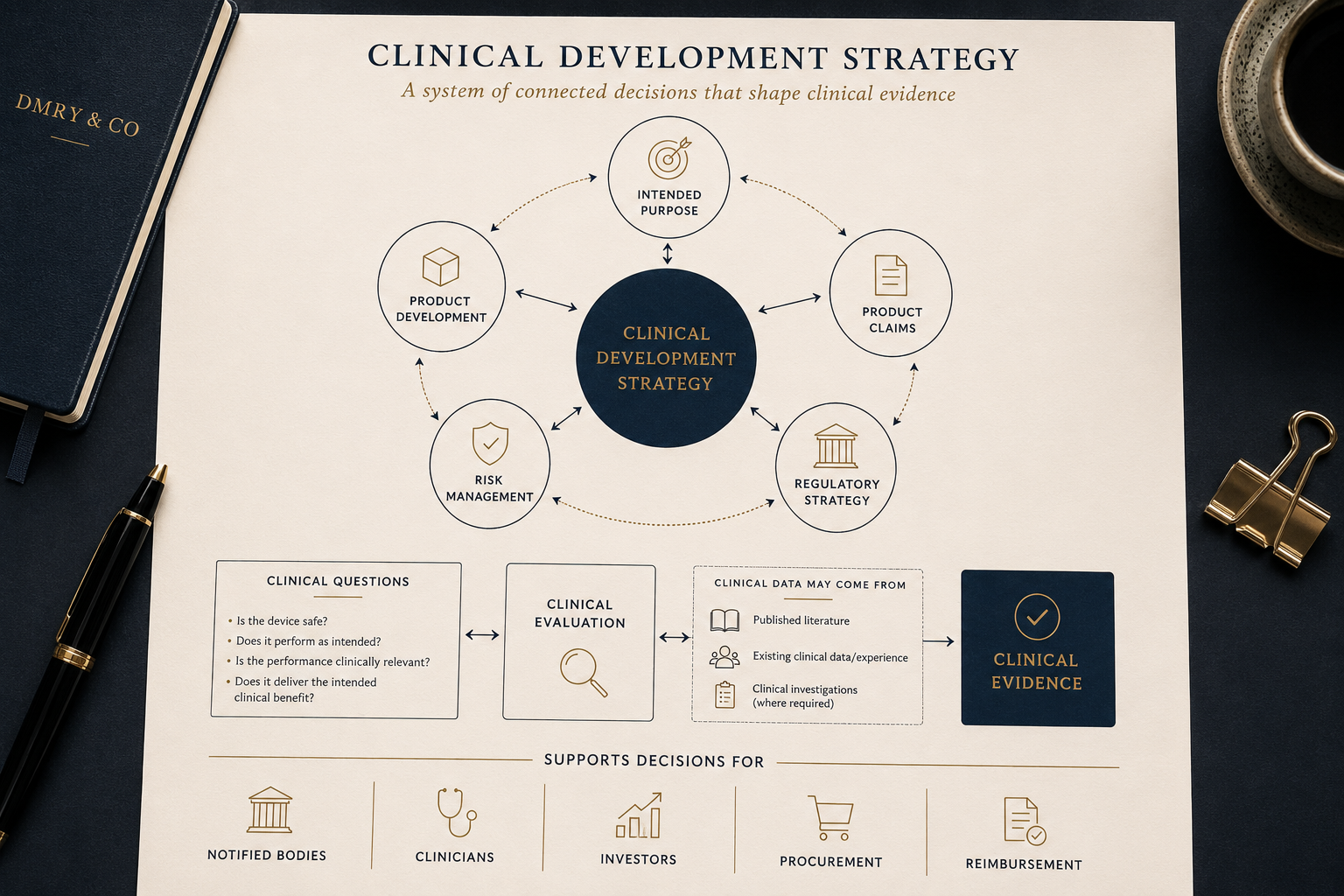
Clinical development is often described as the process of generating the clinical evidence needed to demonstrate that a medical device is safe and performs as intended. While that is true, it also gives the impression that clinical development begins once the product has already been defined.
In reality, the opposite is often true.
By the time the question of clinical evidence comes up, quite a lot has usually already happened. The product has taken shape, there is an Intended Purpose, claims are being discussed and a regulatory pathway may already have been mapped out.
The problem is that those decisions also shape the clinical evidence you will need. And some of them are considerably easier to change before you discover what they mean in terms of studies, timelines and cost.
None of this is particularly unusual. In many early-stage companies, regulatory expertise comes in early, for good reason, to establish the pathway towards market access from a regulatory perspective. Clinical expertise, however, tends to enter the discussion later, often when a specific need for clinical evidence has already been identified.
But the clinical perspective is broader than the evidence required for regulatory approval. It also considers the clinical setting the product is intended to enter, how it fits into current clinical practice and what it will actually need to demonstrate to be clinically relevant.
Those are product questions, not just evidence questions.
You cannot really separate the Intended Purpose from the claims you want to make, or the claims from the evidence you will eventually need to support them. Every time you add a claim, you are also adding another question: how are we going to demonstrate this?
This is where Clinical Development Strategy tends to get reduced to something much narrower than it actually is.
It is often presented as a plan for collecting clinical data or deciding whether a clinical investigation will be required. But the strategy starts earlier, by understanding what the product ultimately needs to demonstrate and whether those ambitions can realistically be supported.
And that cannot be answered by looking at the product alone.
This brings us back to the broader clinical perspective mentioned earlier. The product will enter a clinical context: a particular patient population, clinical pathway and standard of care. That context may look quite different between countries, healthcare systems and even clinical settings.
Treatment guidelines differ, clinical practice evolves and what is considered clinically relevant today may not be exactly what matters by the time the product reaches the market.
Clinical development therefore also means understanding that moving landscape. Where does the product fit? What does it add to current practice? What would constitute a meaningful clinical benefit, and compared with what?
There will rarely be a perfect answer to all of those questions. Clinical Development Strategy is partly about making deliberate choices: understanding which questions matter most, which can realistically be addressed and where uncertainty will have to remain.
From there, the work is to establish the State of the Art: understanding how the condition is currently managed, what treatment or diagnostic options are available, which technologies are already in use and what is known from the published literature.
Evidence from similar or equivalent devices can add another piece to that picture, helping to understand relevant clinical outcomes, known risks and what may reasonably be expected from a new technology.
Against that background, the more important question becomes: what remains unanswered for this particular product?
Only then does it make sense to ask what new clinical data actually need to be generated.
And the answer is not necessarily one study. There may be several clinical questions to address and different ways of addressing them. The point is to understand the evidence that will be needed and how the different pieces fit together before jumping straight to a study design.
The value of doing this work early also reaches well beyond regulatory approval.
The evidence being generated will eventually be looked at by more than a notified body. Investors will use it to assess development risk. Clinicians will want to understand whether the technology adds something meaningful to clinical practice. Procurement teams will compare it with alternatives, and reimbursement bodies may need to understand its value.
They may look at the evidence from very different perspectives, but weak evidence does not suddenly become stronger because the audience has changed.
Clinical development therefore cannot be something that starts once product development has finished doing its part. It is part of product development. Intended Purpose, product claims, product decisions and Clinical Development Strategy need to develop together, because changing one will almost inevitably affect the others.
Clinical evidence is not where this process starts.
It is what comes out at the other end.